Tuesday, 20 March 2012

Sicilian Springtime and Zeppole :-)

Buongiorno a tutti! We are now into spring and even though it has been a novelty this year to see so much snow in Sicily, it is a welcome change to see the nights becoming longer and the beautiful pink bougainvillea coming into bloom.


This is also an exciting time for Sicilian Connections as we have now launched our new online Art Store and are so happy to finally see the Sicilian images taking pride of place on our website. For those who have not yet seen the gallery at www.sicilianconnections.com, the photographs are by the very talented New York photographer Joe Zarba who fell in love with Sicily whilst searching for his ancestral family in Leonforte. The photograph below is one of my personal favourites and is of Bar Vitelli in the town of Savoca. This atmospheric establishment is where Michael Corleone, played by Al Pacino, met Apollonia's father in 'The Godfather' film.


I hope that all Italian fathers enjoyed their 'Festa del Papá' yesterday and that 'le zeppole di San Giuseppe' were eaten in abundance throughout the world :-) For anybody who is not familiar with 'zeppole', they are delicious deep-fried dough balls which can be eaten savoury (for example if filled with ricotta or anchovies) or sweet (eg. filled with cream or smothered with honey). They are traditionally eaten for the 'Festa di San Giuseppe' which is celebrated on the 19th March, but in Sicily, where they are also known as crispelli and sfingi, they are sold throughout the year, especially throughout the summer celebrations. I shall leave you to look at the recipe for ricotta crispelli and to enjoy the gorgeous 'primavera'!

A presto - Debra :-)
www.sicilianconnections.com

                                             Le Zeppole di San Giuseppe/ Crispelli


Ingredients

Vegetable oil for frying
1 cup of flour
2 teaspoons baking powder
2 eggs, beaten
1 cup ricotta cheese
1 pinch salt
1 and a half teaspoons of white sugar
Quarter teaspoon of vanilla extract
Icing sugar for dusting

1) Heat oil in a deep-fryer to 190 degrees (375 degrees F)
2) Combine the flour, baking powder, salt and sugar in a saucepan. Stir in the eggs, ricotta and vanilla and mix gently over a low heat until combined.
3) Drop carefully into the hot oil a few at a time and fry until brown (about 3 minutes).
4) Drain and dust with icing sugar.

Note: In Sicily, the ricotta is usually placed into the middle of the batter but the above method is easier for home baking.

Tuesday, 21 February 2012

La Vita é un Carnevale!

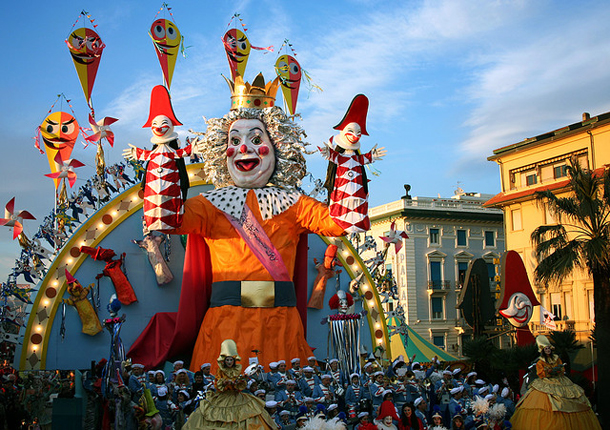
Carnival time is here again amici miei! :-) Italian towns have been taken over by revellers in costume, spectacular street parades and merchant stalls selling every kind of Italian delicacy. The official date of 'Carnevale' this year is the 21st February which is the traditional 40 days before Easter, however many towns have been celebrating for weeks already. Carnevale is the final celebration before the restrictions of Lent - in fact the term is widely recognised as originating from the Latin words 'carnem levare' or 'take away the meat'.


The festival itself is thought to have derived from the ancient Roman 'baccanali', celebrations during which drunken revellers would walk around the city with their faces painted whilst singing, yelling and performing pranks. Tricks and pranks are still an integral part of Carnevale, hence the saying 'a carnevale ogni scherzo vale', meaning that during carnival time any kind of mischief can be expected! The 'Carnevale di Misterbianco' is famous for its wonderful costumes such as that in the image below - modelled on the Amazon Rainforest!


The large colourful floats are also thought to have taken root from ancient Roman times when citizens would hold a festival called Saturnalia to honour the god Saturn, in the hope of achieving a fruitful harvest. During this festival parades of floats carrying masked girls and boys would go along the streets and this tradition is still evident throughout Italy. The 'Carnevale di Acireale' in Sicily is world famous for the colourful paper maché floats that pass through the town and each year there is a competition for the best and most original. For those of you who have never been to a Sicilian 'Carnevale' here is Acireale's promotional video for this year to give you an better idea :-) -


Buon Carnevale a tutti!! Enjoy. A presto,

Debra :-)
www.sicilianconnections.com

Friday, 3 February 2012

Viva Sant'Agata!!

Buona sera a tutti  :-) So much has happened in Italy since my January blog post. First, news travelled quickly throughout the world of the Costa Concordia disaster just off the Tuscan island of Giglio. This was such a tragic incident and our thoughts and prayers go out to the victims and their families. The Italian peninsula was then hit by some of its coldest temperatures in decades. Northern and Central Italy are still suffering from heavy snowfall and even many of the higher towns in Sicily have not been spared this rare occurence.


On a more positive note, we are now entering February which is one of the most festive months in the Sicilian calendar and hopefully the sun will return in preparation for the wonderful Sicilian 'primavera'! Today marks the beginning of the annual three day 'Festa di Sant' Agata' in Catania - a world-famous religious festival which celebrates the city's patron saint and attracts almost a million devotees each year. St. Agata is also the patron saint of fire, earthquakes and Mount Etna eruptions and is buried at the Chapel of Sant' Agata within the majestic Duomo di Catania.


The Saint was martyred in the year 251 aged only fifteen and during the celebration the statue of St. Agata which houses her relics is carried through the streets in a silver carriage, or 'fercolo'. This carriage weighs 40,000 pounds, or 18,000 kilograms. and is pulled by 5,000 local men who are welcomed back to the Duomo with a spectacular firework display.


The traditional festival food for 'La Festa di Sant'Agata' are the delicious, sweet 'Olivette di Sant'Agata'. Here is the recipe for those of you who won't be attending this year's festivities.......Enjoy!


Servings: 6-8
Ingredients: 200 grams almonds, shelled
200 grams sugar
1 tablespoon rum 
sugar for coating
green food colouring
Directions:
Remove the skin from the almonds after immersing for a few seconds in boiling water, and grind together with 100 grams sugar.
Place the remaining sugar in a saucepan with a few tablespoons of water, and heat until it starts to melt. Remove from the heat, and add the almond mixture, rum and a small amount of the green colouring.
Knead until the mixture is smooth.
Rub small balls between the palms into the shape of olives. Coat each “olive” by rolling it in sugar.
Leave for a few hours before serving.

A presto amici,

Debra Santangelo


Thursday, 5 January 2012

Buon Anno Nuovo!

Buona sera a tutti! I would like to wish a very happy new year to all of my amici - I hope that you have had a wonderful Christmas together with your family and friends......wherever in the world you may be!


2011 was a very exciting year for Sicilian Connections. After years of planning and dreaming, www.sicilianconnections.com finally became a reality and I was able, not only to share my own knowledge, thoughts and visions of Sicily, but also to learn about Italian communities around the world. I would like to say a heartfelt 'grazie mille' to everybody who has been involved in the growth of Sicilian Connections - I am really looking forward to seeing what this next year brings .........and also to seeing more of your wonderful photos and captivating stories :-)

I'm sure that many of you have now taken down your Christmas tree and decorations, however in Italy it is tradition to wait for the arrival of 'La Befana' on the 6th January. Folklore tells how an old woman ('La Befana') travels across Italy on a broomstick throughout the eve of the Feast of the Epiphany delivering toys to children that have been good and pieces of coal to those that have not.


This poem is dedicated to the Befana -

La Befana vien di notte
Con le scarpe tutte rotte

Col vestito alla romana
Viva, Viva La Befana!

English translation -

The Befana comes by night
With her shoes all tattered and torn

She comes dressed in the Roman way
Long life to the Befana!

I would like to leave you with this wonderful video taken in Epcot, Disney World in Florida of 'La Befana' telling her enchanting story :-) Enjoy!


A presto :-)

Debra
Sicilian Connections
www.sicilianconnections.com

Sunday, 4 December 2011

'Tis the Season of Sicilian Christmas Markets & Cookies!! :-)

Buona sera a tutti! December has now arrived amici miei ... the cold has set in and the excitement of the festive season can be felt all around us. Many families across the world are now starting to prepare their homes for the Christmas festivities, however in Italy it is tradition to wait for the 8th December to put up the Christmas tree and hang the decorations. This is the Feast of the Immaculate Conception, which celebrates the conception of the Virgin Mary, and it is a public holiday in Italy. This event is celebrated throughout the country with religious street processions such as that shown in the video below in Termini Imerese, Palermo.


This is also the period of the 'Mercatini di Natale', the wonderful Christmas markets, and one that I can highly recommend is that of the 'Mercatino di S.Lucia, Belpasso' in the province of Catania. This is held from the 9th to the 11th December in the beautiful town of Belpasso, which is found on the slopes of Etna, and features stalls selling local delicacies and handmade Christmas crafts. The mountainous setting with its tall pine trees and views of snowy Etna creates the perfect festive atmosphere and the nearby town of Nicolosi even offers outdoor ice-skating.


To celebrate the arrival of the Christmas period I will leave you with a recipe for traditional Sicilian Christmas cookies to enjoy on these dark, winter nights! Enjoy :-)

                                                      Mastazzoli


Ingredients
500g Honey
500g Flour
250g Ground Almonds
200g Grated Dark Chocolate
1/2 tsp Cinnamon
1/2 tsp Cloves

Preparation
Mix together all of the ingredients and place the cookies in the desired form onto a baking tray. Bake at 180 degrees for fifteen to twenty minutes. 

Buonissimi!!
A presto - Debra :-)

Sunday, 13 November 2011

Sicily's Cyclops Riviera - Mystical Tales of Romance and Courage!

One of my favourite parts of Sicily is the 'Riviera dei Ciclopi', or Riviera of the Cyclops, which is a stretch of coastline north of Catania leading from Aci Castello to Acireale. This is such a beautiful part of Sicily and is surrounded by myth and legend. Two of the most popular stories tell of the Cyclops 'Polifemo', the one-eyed giant son of Poseidon (the god of the sea) and Thoosa (a sea nymph).


The first legend comes from Homer's book 'Odyssey' and tells how Ulysses, the King of Ithaca, lands on the island with twelve of his men on his way home from the Trojan War. He ventures into the Cyclop's cave, who then traps the men and eats four of them. In order to escape, Ulysses blinds Polifemo as he sleeps by driving a burning hot stake into his eye. When the Cyclops awakes, he removes the large boulder from the cave's entrance in order to let his sheep out, thus giving Ulysses and his men a chance to escape. As the men escape on their ships, Polifemo tries to stop them by throwing enormous rocks into the sea after them. These rocks can still be seen along the coastline and are known as 'i Faraglioni di Aci Trezza'.


The other legend is much more romantic and tells the mythological story of the beautiful nymph Galatea, the daughter of the sea god 'Nereo', and a young shepherd named Aci. Galatea and Aci were madly in love, however Aci unfortunately had a rival for his lover's affections in the form of the Cyclops Polifemo. One day, Polifemo was so overcome with jealousy that he crushed Aci under an emormous boulder. Jupiter, the king of the gods, took pity on the young couple and turned Aci's blood into a river and the nymph Galatea into sea foam, so that as the river met with the Ionian Sea, the lovers would be united in an eternal embrace.


There are now nine towns that lie in this river's path and all take their name from Aci. My favourite of these are Aci Trezza with its wonderful seafood restaurants, Acireale with its stunning Cathedral and Aci Castello with its breathtaking castle and sea views. This area also holds a special place in my heart as my wedding reception was held at a venue high on an Aci Trezza hill overlooking the Faraglioni :-)


Be sure to add these mystical places to your itinerary if you come to Sicily!

A presto,

Debra :-)
www.sicilianconnections.com

Thursday, 3 November 2011

Cin Cin! Let's drink a 'brindisi' to San Martino.

Cari amici, we are at the start of a new month and, for some, the most important month in the Sicilian calendar. Wine lovers across the island are preparing themselves for the first taste of this year's 'vino nuovo', or new wine, which has now finished fermenting and is ready to enjoy!


The traditional day for this first taste is actually the 11th November which is 'la festa di San Martino', or St. Martin's Day. The Sicilian saying goes - 'a San Martino ogni mustu diventa vinu' - which means that on this day every mosto becomes wine. On this day every year Sicilian vineyards and wine producers open the doors to their cellars to allow patrons their first taste of this year's 'vintage'. Aside from these large producers, many Sicilian individuals make wine from their own grapes and sell it to neighbours and friends. In fact many Sicilian families fill several 15 litre containers with this wine and store it away for the coming months.


Any wine enthusiasts planning to try this 'vino Siciliano' should be warned that this is not comparable to your typical wine - this is an absolutely delicious, but extremely potent version. Beginners should therefore go slow at first to avoid being the first reveller to dance on the tables at the annual 'festa di San Martino'! Personally, I think that it is truly 'buonissimo' :-)


This tradition has lead San Martino to become known as the Patron Saint of drunkards, however his actual story is far more modest. According to folklore San Martino was actually a Roman soldier who later became a monk. One of his most famous legends tells how, on a bitterly cold, stormy and snow-filled day, this soldier cut his cloak in two with his sword to share it with a beggar who he encountered on his travels. He then continued on his way only to find that after several minutes the storm miraculously cleared and the sun came out as a reward. According to the legend this is the reason that we often experience an unseasonal spell of sunny, warm weather at this time of year. This phenomena was originally referred to as 'St. Martin's Summer', however it is now more commonly called an 'Indian Summer'.


Whatever the weather, our Sicilian Connections friends across the globe should be practising their tarantella, opening this year's vino and preparing to pay homage to this time honoured Sicilian festival! Cin cin Amici!

A presto,

Debra :-)
www.sicilianconnections.com