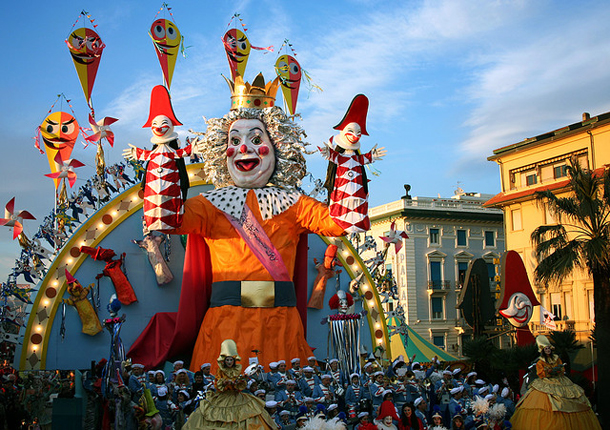
For the past few weeks Italian towns have been taken over by revellers in costume, spectacular street parades and merchant stalls selling every kind of Italian delicacy.The official date of 'Carnevale' this year was the 5th March which is the traditional 40 days before Easter, however many towns were celebrating long before that!
Carnevale is the final celebration before the restrictions of Lent - in fact the term is widely recognised as originating from the Latin words 'carnem levare' or 'take away the meat'.
The festival itself is thought to have derived from the ancient Roman 'baccanali', celebrations during which drunken revellers would walk around the city with their faces painted whilst singing, yelling and performing pranks.
Tricks and pranks are still an integral part of Carnevale, hence the saying 'a carnevale ogni scherzo vale', meaning that during carnival time any kind of mischief can be expected! The 'Carnevale di Misterbianco' is famous for its wonderful costumes such as that in the image below - modelled on an underwater wonderland!
The large colourful floats are also thought to have taken root from ancient Roman times when citizens would hold a festival called Saturnalia to honour the god Saturn, in the hope of achieving a fruitful harvest. During this festival parades of floats carrying masked girls and boys would go along the streets and this tradition is still evident throughout Italy. The 'Carnevale di Acireale' in Sicily is world famous for the colourful paper maché floats that pass through the town and each year there is a competition for the best and most original. I hope you've enjoyed the photos from this year's 'Carnevale'.
Hit reply and let us know if you've ever been to an Italian 'Carnevale' or if you celebrate carnival time in your part of the world.
P.S We've introduced a BRAND NEW payment plan into our 'Sicilian Connections: Discover Your Heritage' online course which starts on Monday! We want to make it as easy as possible for you to join us in this exciting 2 week program and start diving into your Sicilian heritage. Head over to>> Sicilian Connections: Discover Your Heritage now to check out the new payment options.
The private Facebook group is already open and we've had so many members share their wonderful Sicilian stories with us already.
Buongiorno a tutti! I hope that you all had a wonderful Christmas and New Year wherever you are in the world. Here at Sicilian Connections we thoroughly enjoyed the festive period but are very happy to see the evenings become lighter and the early appearance of the Spring sunshine! This also means that it is again time for the wonderful 'Sagra del Mandorlo in Fiore', or the Almond Blossom Festival of Agrigento.
This year will be the 69th edition of the International Festival and will take place from the 8th February to the 16th March. The annual festival takes place in the majestic Sicilian city of Agrigento and celebrates the first almond blossoms of the season - one of the earliest visible signs that Spring is coming. The city will come alive with colourful folk dancers from around the world exhibiting their traditional costumes and dances for the gathered crowds. Local restaurants and bars in the area serve delicious almond dishes and vibrant processions take place throughout the town.
Enjoy this video taken from an Italian news programme which shows last year's festival highlights -
P.S. If you enjoy reading my blog please become a follower by registering at the Google 'Join this site' icon on the right of this blog page. Grazie mille for your support!
Buongiorno a tutti! I hope that you all had a wonderful Summer and had the chance to attend at least one of the wonderful Italian festivals that took place all over the world. One of these festivals was 'La Festa di Santa Rosalia' which took place in the Bensonhurst area of Brooklyn, New York.
When hundreds
of thousands of immigrants left Sicily in the late nineteenth century for the
shores of America they took many of their traditions and customs with them.
This made the transition slightly easier and enabled them to enjoy a piece of
home in this new, unknown land. One of these traditions was the ‘Festa di Santa
Rosalia’ which has been celebrated in Palermo for 389 years and has now become
a long standing tradition in the Italian American community.
The feast
has always been celebrated in Brooklyn but it originally took place in the
parish of the Sacred Hearts and St. Stephen’s Church in Carroll Gardens, which
was Brooklyn’s first Italian parish. The procession originally involved
followers walking barefoot through the streets of the neighbourhood to show
their devotion to the Saint. Since then the festival has been moved to the
Bensonhurst area where it has existed for seventy years.
This year at
5pm each day from 22nd August to the 1st September, 18th
Avenue was closed between 68th Street and Bay Ridge Parkway to allow
local residents to enjoy the offerings of over 100 vendors. These Italian
American merchants offer a wide range of delicious Sicilian specialities such
as cannoli, zeppole and arancini and families from across the city came
together to experience this time honoured tradition. Many Sicilian families
have moved away from these tight-knit communities in recent years and the Feast
of Santa Rosalia often provides the ideal opportunity to come together and
share stories of their ancestry and heritage.
There was,
however, some controversy surrounding the festival this year. It was originally
thought that the feast may have to be cancelled, as it was in 2011, due to problems
with street-closure permits and other paperwork issues. Thankfully these issues
were resolved at the last minute and it is the wish of this loyal and devoted
community that the ‘Festa di Santa Rosalia’ will continue to survive long into
the future.
Amici, if you enjoy reading my blog please become a follower by registering at the Google 'Join this site' icon at the top right of the page. Grazie mille for your support!!
Buongiorno a tutti i miei amici!! I hope that you are all well and finally enjoying some Spring sunshine :-)
We are now in Easter week which is one of the most significant periods in the Sicilian calendar. Every year, the atmosphere in Sicilian towns changes considerably throughout the week according to the day and its religious implications. Even the weather usually changes accordingly, with the week prior to Easter being dark and miserable only to give way to glorious sunshine on Easter Sunday. My own personal experiences of the week's events have mostly been in the town of Adrano, which is situated at the foot of Mount Etna, in the province of Catania. The processions are so elaborate and moving in this town, and they attract thousands of devotees.
Today the procession of 'Cristo alla Colonna' takes place from 6pm until 3am tomorrow morning, when the statue of Christ on the cross is carried throughout the streets of Adrano, calling in at each of the town's churches in order for the men carrying the statue to kneel at each altar. This is so emotional to watch as the statue is carried very slowly, three steps forward then two steps back, and sways from side to side.
On Good Friday from 7am until 2pm the statue of the Virgin Mary, l'Addolorata, is carried through the streets visiting each church looking for her son Jesus, and at 8pm there is the procession of 'Cristo Morto'. In dialect, this is 'U Lizzanti' and is the statue of the body of Jesus which makes four stops around the town, each time accompanied by a marching band playing the funeral song 'Canzoncina a Gesù morto'.
On Easter Sunday the sun shines bright in the sky and hundreds of families head towards the town centre to see the procession of 'Cristo Risorto' (Christ Resurrected), the Angel and of 'Maria Annunziata' (Virgin Mary).
The happiest time of the day is when the statues of Jesus and Mary finally meet and this is known as 'A Paci'. The statues are made to dance and kiss and the atmosphere in the piazza is so happy and uplifting. Adrano is renowned for 'la Diavolata', which is a theatrical production held outside in the piazza on Easter Sunday and depicts the fight between good (symbolised by angels) and evil (the devils). In the evening the town holds an incredible fireworks display.
I wish each one of you a 'Buona Pasqua' and leave you with a video in Italian showing the highlights of Easter in Adrano -
Amici, if you enjoy reading my blog please become a follower by registering at the Google 'Join this site' icon at the top right of the page. Grazie mille for your support!!
Buongiorno amici! I hope that many of you, even if you are not in Italy, have had the chance to enjoy some 'Carnevale' celebrations, or at least had the pleasure of enjoying some of the delicious Carnival food sold around the world!
Next week, on the 19th February, the Siracusan city of Noto will celebrate its Patron Saint and protector, San Corrado. Corrado Confalonieri originated from 14th century Piacenza and chose to leave all of his possessions behind to become a Franciscan monk and undertake a pilgrimage across Italy. He eventually retreated to a grotto in Noto and lived his life as a reclusive hermit. He was known as a kind, generous man who performed many miracles and when he died on the 19th February 1351, legend has it that the church bells started to ring of their own accord.
Church of San Corrado - Valley of the Miracles
Corrado was made a Saint on the 28th August 1515 and his mortal remains are carried through the streets of Noto in both February and August to commemorate his life and good deeds. These celebrations are renowned as being among the most poignant on the island of Sicily and thousands of Sicilians come to the town each year in honour of the Saint; many of the devoted followers choose to follow the procession barefoot. A marching band leads the procession and in the evening there is a spectacular firework display which can be witnessed from miles around.
The city of Noto is famous for its 18th Century buildings including the beautiful cathedral and has been declared a UNESCO World Heritage Site. You can read about Noto's annual flower festival which takes place in May in last year's blog post - http://sicilianconnections.blogspot.co.uk/2012/05/baroque-noto-in-bloom.html.
Enjoy this Italian video documentary about last August's San Corrado festival in Noto, made by a local news team -
P.S. If you enjoy reading my blog please become a follower by registering at the Google 'join this site' icon at the top of the blog page. Grazie mille for your support!!
Buongiorno a tutti! As the evenings start to turn lighter and we head into February, many of us start to look forward to the onset of Spring. The winter snow was fun and Christmas was enchanting as always, but I, for one, am certainly ready for the first rays of Spring sunshine to make their appearance.
On that note, I would like to talk about one of my favourite events in Sicily - La Sagra del Mandorlo in Fiore or 'the Almond Blossom Festival'. This annual event takes place in the majestic city of Agrigento and celebrates the first almond blossoms of the season - one of the earliest visible signs that Spring is coming.
The main city of Agrigento lies on a plateau overlooking the Mediterranean Sea on the southern coast of Sicily. It is the site of the ancient city of Akragas which dates back to around 580 BC and was described by the poet Pyndar as ''the most beautiful of mortal cities''. A great number of visitors come to the area to view some of the best-preserved Ancient Greek temples outside of Greece itself, which are situated in the 'Valle dei Templi' (Valley of the Temples) to the south of the city. This is now a UNESCO World Heritage Site.
From the 1st until the 10th February, the city comes alive with colourful folk dancers from across the world exhibiting their traditional costumes and dances for the gathered crowds. Local restaurants and bars in the area serve delicious almond dishes and vibrant processions take place throughout the town.
Enjoy this wonderful video which shows the festival's highlights from last year -
P.S.
If you enjoy reading my blog please become a follower by registering at the
Google 'Join this site' icon on the right of the blog page. Grazie mille for
your support!!
Buona sera a tutti! With memories of Christmas fading fast and the mountainous supply of panettone finally coming to an end, this can only mean one thing ....... it's Carnival time!! Carnevale in Italy is one of the year's biggest celebrations and towns throughout the peninsula come alive with music, parades and concerts. The word 'Carnevale' is thought to originate from the Latin words 'carnem levare' which literally mean 'to take away the meat', and this highlights the true reason for the festival which is to enjoy a final party before the restrictions of Lent.
Many towns, such as Venice, celebrate 'Carnevale' in February but, this year, the most famous carnival in Sicily will commence on Saturday 26th January in Acireale. On this day there will be a spectacular inaugural parade around the town at 5pm and then, until the 12th February, Acireale will be a flurry of amazing colours, embellished floats and, of course, mouth-watering Sicilian delicacies. The floats are enormous decorated platforms made by residents of the town and are judged throughout the competition for their design and originality. The winners will be announced at 11pm on the final day.
Other towns in Sicily which are renowned for their spectacular carnivals are Misterbianco, in the province of Catania, Sciacca in Agrigento and Termini Imerese in Palermo.
For a taste of what you can expect from the 'Carnevale di Acireale' enjoy this video of one of last year's finalists -
Buon Carnevale a tutti! I hope you get the chance to enjoy carnival time wherever you are in the world. Be sure to share your photos and stories with us as always.
P.S. If you enjoy reading my blog please become a follower by registering at the
Google 'Join this site' icon on the right of the blog page. Grazie mille for
your support!!
Buona sera amici! We are now into October which, in the USA, is celebrated as 'National Italian Heritage Month'. Throughout America there will be numerous celebrations highlighting the sense of pride and loyalty felt towards Italy by the many immigrants who left the peninsula long ago.
Between the years of 1861 and 1965, almost 25 million Italians left the peninsula in search of a new life. This is considered to be the biggest mass migration of contemporary times and, in Sicily, was partly due to the drop in economy and over-population experienced after the unification of Italy.
In 1906 alone, 100,000 Sicilians emigrated to the United States of America and in 1920, 87 percent of Sicilian immigrants were still headed for the US. Other countries with a significant number of Sicilian immigrants were Venezuela, Brasil, Mexico, Canada, Australia and other countries throughout Europe. Some of the main cities in America where Sicilians settled were New York, Boston, Chicago and San Francisco and these immigrants tended to reside together in groups depending on the area that they came from. For example, in New Orleans there was a district called ‘Little Palermo’.
These Sicilians were so passionate about their homeland that they took many of their traditions and values with them. They believed in these customs so much that many aspects of Sicilian life have become an intrinsic part of communities worldwide and are still very much in evidence today. Throughout the year there are festivals across the world to celebrate different Sicilian traditions. The island’s way of life is echoed daily in neighbourhoods worldwide through their cuisine, language and culture, such as the music listened to or the plays seen at the theatre.
An example of a tradition which has been taken to America is the ‘Festa di Santa Rosalia’ in Brooklyn which is dedicated to the Patron Saint of Palermo. This annual festival originally took place in the first Italian parish in Brooklyn, the Sacred Hearts and St. Stephens Church in Carroll Gardens, and has since been moved to the community of Bensonhurst. The procession originally involved followers walking barefoot through the streets of the neighbourhood to show their devotion to the Saint.
Every year Italian-American merchants set up stalls at the various festivals around the country selling Sicilian specialities such as ‘cannoli’, zeppole’ and ‘arancini’ and entire communities come together to celebrate their heritage and tell stories about their ancestry. It is viewed as a real honour to belong to such a loyal and devoted community and it is this devotion that will ensure that the respect for ‘u paese vecchiu’, or the old country, will stay strong long into the future.
I created Sicilian Connections because over the years I have met many people of Sicilian origin that, for various reasons, have emigrated and live in different locations worldwide, but the passion that they feel for their homeland has remained strong. It was my aim to create a community where Sicilians could come together and share their wonderful stories of the island and memories of their ancestors and, thanks to the pride and devotion of our Sicilian Connections friends worldwide, this is now a reality.
P.S. If you enjoy reading my blog please become a follower by registering at the
Google 'Join this site' icon on the right of the page. Grazie mille for your
support!!
Buongiorno a tutti! I hope that wherever you are in the world you are enjoying some of the summer sun which is currently in abundance on the island of Sicily. Temperatures have been consistently hitting 40 degrees celsius and across the island beaches are full of both residents and holiday makers looking for a welcome escape from the midsummer heat.
Next week it will officially be midsummer according to the Italian calendar as the entire peninsula celebrates 'Ferragosto' on the 15th August. This festival derives from the Latin Feriae Augusti (the holidays of the Emperor Augustus) and traditionally celebrates summer and the end of hard labour in the fields. In the past, businesses used to close for the whole month of August and even now offices often close for at least one week as Italians travel to the beach for their annual holiday. Cities across the country become almost deserted apart from the ever-present tourists as residents leave the humid city air behind for the unrivalled beauty of the Italian coastline.
Many families and groups of friends actually make their way to the beaches on the evening of the 14th August to light campfires and spend the night under the stars. This often coincides with the peak activity of the Perseid Meteor Shower which is generally between the 9th and the 14th August - providing beach-goers with a front row seat for this spectacular sky scene. According to tradition, the falling stars represent the tears of St. Lawrence who was buried on the 10th August 258 A.D. following a martyr's death. In fact, the Night of St. Lawrence (or La Notte di San Lorenzo) is an enchanting occasion for Italians who look to the sky in the hope of making a wish on a shooting star.
In the early morning of Ferragosto, revellers sit around their campfires and watch the famous Sicilian sunrise before making their way to the nearby beach-front cafés for a morning espresso and delicious granita. This is one of my favourite Italian traditions and one which is now celebrated around the world. An example of this is in Arthur Avenue, New York (or Little Italy in the Bronx) where over 15,000 Italian Americans take to the streets each year in September to enjoy their ancestor's fascinating culture and delicious food.
Buon Ferragosto amici! I hope that you will find a summer celebration near you ... and if not, at least be sure to look up to the sky next week and be ready to make a wish!
P.S. If you enjoy reading my blog please become a follower by registering at the
Google 'Join this site' icon on the right of the page. Grazie mille for your
support!!
Buona sera amici. I would like to start this new blog post by sending my thoughts and prayers out to those affected by the tragic earthquake that struck Emilia Romagna yesterday. To suffer again only ten days after the last earthquake hit the region is terrible and I am sure that you all join me in sending out our sincere condolences to the families of the victims.
On the last Sunday in May every year there is a spectacular feast day held in Ragusa dedicated to the Patron Saint of Ragusa Ibla - St. George or San Giorgio. This year it will actually be held on the 3rd June but the celebrations last across the whole weekend.
The Cathedral of San Giorgio is a beautiful example of Baroque architecture and is characterised by its ornate facade featuring 250 steps and enormous intricate columns. Each evening throughout the celebrations this Cathedral, or Duomo, will be spectacularly lit up and in the Piazza Duomo there will be live events and music bands.
On the Sunday of the 'festa', the statue of San Giorgio, which was sculpted by the Palermitan Rosario Bagnasco in the second half of the 19th century, is paraded through the streets of Ragusa Ibla on the shoulders of devotees. This is followed by a marching band and hundreds of the town's residents and Sicilians who come to Ragusa for the celebrations. When the procession is over, there is a spectacular firework display in the Piazza Duomo which is famous for its elaborate exhibition and magnificent colours that light up the night.
If you won't make it to these wonderful celebrations, take a look at the beautiful video below to see what it is that attracts devotees from across the island -
P.S. If you enjoy reading my blog please become a follower by registering at the
Google 'Join this site' icon at the top right of the page. Grazie mille for your
support!!
Buongiorno a tutti! I hope that you are all well and that you acted upon my previous blog post's advice to indulge in a Spring Sicilian 'scampagnata'! Today I want to talk about the Infiorata di Noto which is due to take place from the 18th to the 21st of May in the Siracusan town of Noto. This is a beautiful flower festival which takes place each year on the third Sunday of May.
On the Friday of the festival, artists start to create their own individual work of art with flower petals, organic seeds and a special kind of soil. These pieces all come together to create a beautiful flower scene stretching all of the way along the Via Corrado Nicolaci. The stunning effect is almost like a stained glass window and leads up to Chiesa di Montevergini which is also worth a visit to see its beautiful ornate marble altar and concave facade. Hundreds of visitors will come to the festival over the weekend to enjoy the 'Infiorata' and on the Monday local children will be allowed to run through the flowers to destroy the exhibit until next year.
Via Corrado Nicolaci is also home to the elegant Palazzo Nicolaci, a Baroque-style residence which now houses the local library and is renowned for its intricate balconies such as the one in the image below. The city of Noto is famous for its 18th century buildings including its beautiful cathedral and has been declared a UNESCO World Heritage Site
Anyone who won't be able to make it to Noto for the flower festival should at least make a visit to our new Facebook group - Siclian Connections 'La Piazza' at the following link -http://www.facebook.com/sicilian.connections#!/groups/304770149603514/. This group has been created to allow our friends across the world to share their favourite Sicilian photographs and songs so please join us!
P.S. If you enjoy reading my blog please become a follower by registering at the
Google 'Join this site' icon at the top right of the page. Grazie mille for your
support!!
Buongiorno a tutti i miei amici!! I hope that you are all well and enjoying the Spring sunshine :-)
We are now entering a period which, to me, is the most significant week in the Sicilian calendar, and that is Easter. Every year, the atmosphere in Sicilian towns changes considerably throughout the week according to the day and its religious implications. Even the weather usually changes accordingly, with the week prior to Easter being dark and miserable, only to give way to glorious sunshine on Easter Sunday. My own personal experiences of the week's events have mostly been in the town of Adrano, which is situated at the foot of Mount Etna, in the province of Catania. The processions are so elaborate and moving here, and they attract thousands of devotees.
Today the procession of 'Cristo alla Colonna' takes place from 6pm until 3am tomorrow morning, when the statue of Christ on the cross is carried throughout the streets of Adrano, calling in at each of the town's churches in order for the men carrying the statue to kneel at each altar. This is so emotional to watch as the statue is carried very slowly, three steps forward then two steps back, and sways from side to side. On Good Friday from 7am until 2pm the statue of the Virgin Mary, l'Addolorata, is carried through the streets visiting each church looking for her son Jesus, and at 8pm there is the procession of 'Cristo Morto'. In dialect, this is 'U Lizzanti' and is the statue of the body of Jesus which makes four stops around the town, each time accompanied by a marching band playing the funeral song 'Canzoncina a Gesù morto'.
On Easter Sunday the sun is normally bright in the sky and hundreds of families head towards the town centre to see the procession of 'Cristo Risorto' (Christ Resurrected), the Angel and of 'Maria Annunziata' (Virgin Mary). The happiest time of the day is when the statues of Jesus and Mary finally meet and this is known as 'A Paci'. The statues are made to dance and kiss and the atmosphere in the piazza is so happy and uplifting. Adrano is renowned for 'la Diavolata', which is a theatrical production held outside in the piazza on Easter Sunday and depicts the fight between good (symbolised by angels) and evil (the devils). In the evening the town holds an incredible fireworks display.
I wish each one of you a 'Buona Pasqua' and will leave you with a video in Italian showing the highlights of Easter in Adrano -
Amici, if you enjoy reading my blog please become a follower by registering at the Google 'Join this site' icon at the top right of the page. Grazie mille for your support!!
Buongiorno a tutti! We are now into spring and even though it has been a novelty this year to see so much snow in Sicily, it is a welcome change to see the nights becoming longer and the beautiful pink bougainvillea coming into bloom.
This is also an exciting time for Sicilian Connections as we have now launched our new online Art Store and are so happy to finally see the Sicilian images taking pride of place on our website. For those who have not yet seen the gallery at www.sicilianconnections.com, the photographs are by the very talented New York photographer Joe Zarba who fell in love with Sicily whilst searching for his ancestral family in Leonforte. The photograph below is one of my personal favourites and is of Bar Vitelli in the town of Savoca. This atmospheric establishment is where Michael Corleone, played by Al Pacino, met Apollonia's father in 'The Godfather' film.
I hope that all Italian fathers enjoyed their 'Festa del Papá' yesterday and that 'le zeppole di San Giuseppe' were eaten in abundance throughout the world :-) For anybody who is not familiar with 'zeppole', they are delicious deep-fried dough balls which can be eaten savoury (for example if filled with ricotta or anchovies) or sweet (eg. filled with cream or smothered with honey). They are traditionally eaten for the 'Festa di San Giuseppe' which is celebrated on the 19th March, but in Sicily, where they are also known as crispelli and sfingi, they are sold throughout the year, especially throughout the summer celebrations. I shall leave you to look at the recipe for ricotta crispelli and to enjoy the gorgeous 'primavera'!
Vegetable oil for frying
1 cup of flour
2 teaspoons baking powder
2 eggs, beaten
1 cup ricotta cheese
1 pinch salt
1 and a half teaspoons of white sugar
Quarter teaspoon of vanilla extract
Icing sugar for dusting
1) Heat oil in a deep-fryer to 190 degrees (375 degrees F)
2) Combine the flour, baking powder, salt and sugar in a saucepan. Stir in the eggs, ricotta and vanilla and mix gently over a low heat until combined.
3) Drop carefully into the hot oil a few at a time and fry until brown (about 3 minutes).
4) Drain and dust with icing sugar.
Note: In Sicily, the ricotta is usually placed into the middle of the batter but the above method is easier for home baking.
Carnival time is here again amici miei! :-) Italian towns have been taken over by revellers in costume, spectacular street parades and merchant stalls selling every kind of Italian delicacy. The official date of 'Carnevale' this year is the 21st February which is the traditional 40 days before Easter, however many towns have been celebrating for weeks already. Carnevale is the final celebration before the restrictions of Lent - in fact the term is widely recognised as originating from the Latin words 'carnem levare' or 'take away the meat'.
The festival itself is thought to have derived from the ancient Roman 'baccanali', celebrations during which drunken revellers would walk around the city with their faces painted whilst singing, yelling and performing pranks. Tricks and pranks are still an integral part of Carnevale, hence the saying 'a carnevale ogni scherzo vale', meaning that during carnival time any kind of mischief can be expected! The 'Carnevale di Misterbianco' is famous for its wonderful costumes such as that in the image below - modelled on the Amazon Rainforest!
The large colourful floats are also thought to have taken root from ancient Roman times when citizens would hold a festival called Saturnalia to honour the god Saturn, in the hope of achieving a fruitful harvest. During this festival parades of floats carrying masked girls and boys would go along the streets and this tradition is still evident throughout Italy. The 'Carnevale di Acireale' in Sicily is world famous for the colourful paper maché floats that pass through the town and each year there is a competition for the best and most original. For those of you who have never been to a Sicilian 'Carnevale' here is Acireale's promotional video for this year to give you an better idea :-) -
Buona sera a tutti :-) So much has happened in Italy since my January blog post. First, news travelled quickly throughout the world of the Costa Concordia disaster just off the Tuscan island of Giglio. This was such a tragic incident and our thoughts and prayers go out to the victims and their families. The Italian peninsula was then hit by some of its coldest temperatures in decades. Northern and Central Italy are still suffering from heavy snowfall and even many of the higher towns in Sicily have not been spared this rare occurence.
On a more positive note, we are now entering February which is one of the most festive months in the Sicilian calendar and hopefully the sun will return in preparation for the wonderful Sicilian 'primavera'! Today marks the beginning of the annual three day 'Festa di Sant' Agata' in Catania - a world-famous religious festival which celebrates the city's patron saint and attracts almost a million devotees each year. St. Agata is also the patron saint of fire, earthquakes and Mount Etna eruptions and is buried at the Chapel of Sant' Agata within the majestic Duomo di Catania.
The Saint was martyred in the year 251 aged only fifteen and during the celebration the statue of St. Agata which houses her relics is carried through the streets in a silver carriage, or 'fercolo'. This carriage weighs 40,000 pounds, or 18,000 kilograms. and is pulled by 5,000 local men who are welcomed back to the Duomo with a spectacular firework display.
The traditional festival food for 'La Festa di Sant'Agata' are the delicious, sweet 'Olivette di Sant'Agata'. Here is the recipe for those of you who won't be attending this year's festivities.......Enjoy!
Servings:
6-8
Ingredients:
200 grams almonds, shelled
200 grams sugar
1 tablespoon rum
sugar for coating
green food colouring
Directions:
Remove the skin from the almonds after immersing for a few seconds in boiling water, and grind together with 100 grams sugar. Place the remaining sugar in a saucepan with a few tablespoons of water, and heat until it starts to melt. Remove from the heat, and add the almond mixture, rum and a small amount of the green colouring. Knead until the mixture is smooth. Rub small balls between the palms into the shape of olives. Coat each “olive” by rolling it in sugar. Leave for a few hours before serving.
Buona sera a tutti! December has now arrived amici miei ... the cold has set in and the excitement of the festive season can be felt all around us. Many families across the world are now starting to prepare their homes for the Christmas festivities, however in Italy it is tradition to wait for the 8th December to put up the Christmas tree and hang the decorations. This is the Feast of the Immaculate Conception, which celebrates the conception of the Virgin Mary, and it is a public holiday in Italy. This event is celebrated throughout the country with religious street processions such as that shown in the video below in Termini Imerese, Palermo.
This is also the period of the 'Mercatini di Natale', the wonderful Christmas markets, and one that I can highly recommend is that of the 'Mercatino di S.Lucia, Belpasso' in the province of Catania. This is held from the 9th to the 11th December in the beautiful town of Belpasso, which is found on the slopes of Etna, and features stalls selling local delicacies and handmade Christmas crafts. The mountainous setting with its tall pine trees and views of snowy Etna creates the perfect festive atmosphere and the nearby town of Nicolosi even offers outdoor ice-skating.
To celebrate the arrival of the Christmas period I will leave you with a recipe for traditional Sicilian Christmas cookies to enjoy on these dark, winter nights! Enjoy :-)
Cari amici, we are at the start of a new month and, for some, the most important month in the Sicilian calendar. Wine lovers across the island are preparing themselves for the first taste of this year's 'vino nuovo', or new wine, which has now finished fermenting and is ready to enjoy!
The traditional day for this first taste is actually the 11th November which is 'la festa di San Martino', or St. Martin's Day. The Sicilian saying goes - 'a San Martino ogni mustu diventa vinu' - which means that on this day every mosto becomes wine. On this day every year Sicilian vineyards and wine producers open the doors to their cellars to allow patrons their first taste of this year's 'vintage'. Aside from these large producers, many Sicilian individuals make wine from their own grapes and sell it to neighbours and friends. In fact many Sicilian families fill several 15 litre containers with this wine and store it away for the coming months.
Any wine enthusiasts planning to try this 'vino Siciliano' should be warned that this is not comparable to your typical wine - this is an absolutely delicious, but extremely potent version. Beginners should therefore go slow at first to avoid being the first reveller to dance on the tables at the annual 'festa di San Martino'! Personally, I think that it is truly 'buonissimo' :-)
This tradition has lead San Martino to become known as the Patron Saint of drunkards, however his actual story is far more modest. According to folklore San Martino was actually a Roman soldier who later became a monk. One of his most famous legends tells how, on a bitterly cold, stormy and snow-filled day, this soldier cut his cloak in two with his sword to share it with a beggar who he encountered on his travels. He then continued on his way only to find that after several minutes the storm miraculously cleared and the sun came out as a reward. According to the legend this is the reason that we often experience an unseasonal spell of sunny, warm weather at this time of year. This phenomena was originally referred to as 'St. Martin's Summer', however it is now more commonly called an 'Indian Summer'.
Whatever the weather, our Sicilian Connections friends across the globe should be practising their tarantella, opening this year's vino and preparing to pay homage to this time honoured Sicilian festival! Cin cin Amici!


.jpg)