Wednesday, 25 September 2013

A Sicilian's Journey - Book Review

Buongiorno a tutti! This month we have had the pleasure of reviewing a wonderful book written by William V. Fioravanti. It is a truly captivating read and I would recommend it to anyone with an interest in Sicily and in Italian immigration. For those of you who have not yet seen the article on our website (www.sicilianconnections.com) here is the author's description of his book and our review -

William V. Fioravanti’s Book Description

This is a non-fiction account of the life of my grandfather. His life starts in Sicily and follows him through his arrival in New York and his experiences in the small colonial town of Johnstown and twin city Gloversville. Although it is not permeated with gangsters and violence, there is much action. Life for immigrants in these small upstate New York villages was not a simple transition and there are plenty of unusual happenings.

I wrote this story as a treatment for a screenplay and when you peruse the work you will see how it flows from chapter to chapter. Some chapters are short but still very visual. It is my sincerest desire that you will find a very unusual and exciting journey of a Sicilian immigrant striving to survive in a new and fast changing world.
 
Review
History, love and passion are all prevalent in great abundance in A Sicilian’s Journey. This book is full of interesting information about the actual events of one family taken from all aspects. I have a great interest in Sicilian culture and the history of Sicilian immigration to America and gained much knowledge from reading this book. As soon as I had read two chapters I was engrossed to see how the story unravelled and to reveal the final outcome.

The story begins in Sicily in 1878 with Vincenzo Saviotti. Many villages at the time, although beautiful and historic, did not have an economy that could support families. Although the Saviotti family had lived in a small Sicilian village called Castelmola for many years, Vincenzo decided to take his trade as a cobbler to Messina. It is from this decision that the story of the Fioravanti and Andreana family begins. As Castelmola, close to Taormina, is a town that I visit often, I was very interested to read the differences between the Castelmola that I am familiar with now and that of two hundred years ago.
 

A Sicilian’s Journey moves between different points in time and focuses on different characters of this Sicilian family. It is written in such a way that is flows effortlessly from one section to another. I have found the family completely fascinating and I particularly enjoyed reading about Guglielmo Fioravanti, the author’s Grandfather, and genuinely cared about him. As I was reading the book, I constantly wanted to find out more about the journey of Guglielmo, and all of his family members, and what happened to them.

Sicilian Americans would relate to this book tremendously; I personally found it a truly emotional read. I experienced a wide range of feelings and became very involved with the story. It was easy to picture it all in my mind, making it very real and prompting me to learn more about the immigration of Italian Americans and the harsh reality of it; the dreadful conditions on the ships, the claustrophobia, the dysentery and disease... how did they manage to survive?

The fact that Italians changed their names from their own Italian birth names to American names highlights the prejudice felt by the immigrants and the measures that they were forced to take in order to be accepted. They faced terrible unemployment and difficult housing situations due to their Italian nationality and allegedly ‘lowly’ stature in America. It is easy to see why Ellis Island became known as the ‘Island of Tears’.

I was truly compelled by this book and by Guglielmo Fioravanti who, with great foresight, kindness, generosity and hard work for his family allowed them to prosper and to be blessed in his choice to relocate to the northern New York state of Johnstown. This lovely book is a must-read.

A Sicilian’s Journey can be purchased to read on your Kindle at the following link - http://www.amazon.co.uk/A-Sicilians-Journey-ebook/dp/B00CUMSMXI.
 
A presto,
Debra Santangelo

Monday, 9 September 2013

La Festa di Santa Rosalia - Bensonhurst

Buongiorno a tutti! I hope that you all had a wonderful Summer and had the chance to attend at least one of the wonderful Italian festivals that took place all over the world. One of these festivals was 'La Festa di Santa Rosalia' which took place in the Bensonhurst area of Brooklyn, New York.


When hundreds of thousands of immigrants left Sicily in the late nineteenth century for the shores of America they took many of their traditions and customs with them. This made the transition slightly easier and enabled them to enjoy a piece of home in this new, unknown land. One of these traditions was the ‘Festa di Santa Rosalia’ which has been celebrated in Palermo for 389 years and has now become a long standing tradition in the Italian American community.

The feast has always been celebrated in Brooklyn but it originally took place in the parish of the Sacred Hearts and St. Stephen’s Church in Carroll Gardens, which was Brooklyn’s first Italian parish. The procession originally involved followers walking barefoot through the streets of the neighbourhood to show their devotion to the Saint. Since then the festival has been moved to the Bensonhurst area where it has existed for seventy years.
 

This year at 5pm each day from 22nd August to the 1st September, 18th Avenue was closed between 68th Street and Bay Ridge Parkway to allow local residents to enjoy the offerings of over 100 vendors. These Italian American merchants offer a wide range of delicious Sicilian specialities such as cannoli, zeppole and arancini and families from across the city came together to experience this time honoured tradition. Many Sicilian families have moved away from these tight-knit communities in recent years and the Feast of Santa Rosalia often provides the ideal opportunity to come together and share stories of their ancestry and heritage.

There was, however, some controversy surrounding the festival this year. It was originally thought that the feast may have to be cancelled, as it was in 2011, due to problems with street-closure permits and other paperwork issues. Thankfully these issues were resolved at the last minute and it is the wish of this loyal and devoted community that the ‘Festa di Santa Rosalia’ will continue to survive long into the future.
Amici, if you enjoy reading my blog please become a follower by registering at the Google 'Join this site' icon at the top right of the page. Grazie mille for your support!!
A presto!
Debra Santangelo
 

Friday, 28 June 2013

Interview with Professor Philip J. DiNovo


Buongiorno a tutti! This week I had the honour of speaking to Professor Philip J. DiNovo who is the Founder and President of the esteemed American Italian Heritage Association and the American Italian Heritage Museum in Albany, New York. He has also been knighted by the Italian Government and is a respected figure in America’s Italian community.

Mr. DiNovo agreed to provide our readers with further information about his organisation and about his own connections to the island of Sicily and here is our exclusive interview :-) I hope you enjoy it!

image

Good Evening. Please can you tell us about The American Italian Heritage Association and how it was originally founded?

I founded the American Italian Heritage Association in 1979. Our mission is to record and preserve our Italian heritage.
 

The Association has been involved in many projects throughout the Italian American Community. Can you tell us about some of these activities?

We offer many programs, events and classes to carry out our mission. We are a resource for all things Italian in the community. We publish a 20 page bi-monthly newsletter in English that goes to our members in 37 states and several countries.

 How did the opening of the American Italian Heritage Museum come about?

In 1985 I founded the American Italian Heritage Museum in Utica, NY and closed it in 1997. We then moved to Albany, NY and our campus has three buildings. Our museum is in a former church and there are ten rooms of exhibits, the Hall of History, the Donor Tree in the Reception Room, the Gift Shop and two offices. Our museum is the largest Italian American room in the Eastern part of the USA. On the second floor (1,900 sq ft.) will be our Italian Cultural Center.

 
Can you please give us some insight into what visitors to your wonderful museum can expect to see?

Our Museum has the following rooms: Immigrant (2), Italian Folk Art, Religious, Italian American Music, Old Photo, Hall of History, Contribution of Italian Americans, Art, Special Exhibit and Military.

The museum honors the Italian Immigrants; we tell their story and we tell of the contributions of Italian Americans.
 
File:Termini imerese bjs07-01.jpg
 
 
One of the museum's current exhibits is 'My Sicily, Lights and Color' by the Sicilian artist, Joseph Anastasio. Can you tell us some more about this exhibit?
 
'My Sicily, Lights and Color' Exhibit is by a member born in Sicily, Joseph Anastasio. The paintings are of Sicily and its people and his body of work shows a tremendous love for, and understanding of, his land. Almost all of his works are painted on ceramic tiles, illustrating scenes of Sicily with its beautiful landscapes, its people, its villages, but most of all the sea and the unforgettable sunsets. In his landscapes, you will find monuments from the ancient Greeks, Romans, Arabs, Byzantines and Normans. All of these people left a legacy of their cultures to Sicily and the Aeolian Islands. Through his art, Joe Anastasio shows us the Sicily that he will never forget and never stop loving.

Do you have Sicilian connections yourself?

Yes, both sets of my grandparents were born in Sicily.

Please can you tell us about where your Grandparents are from and how your family came to live in America?

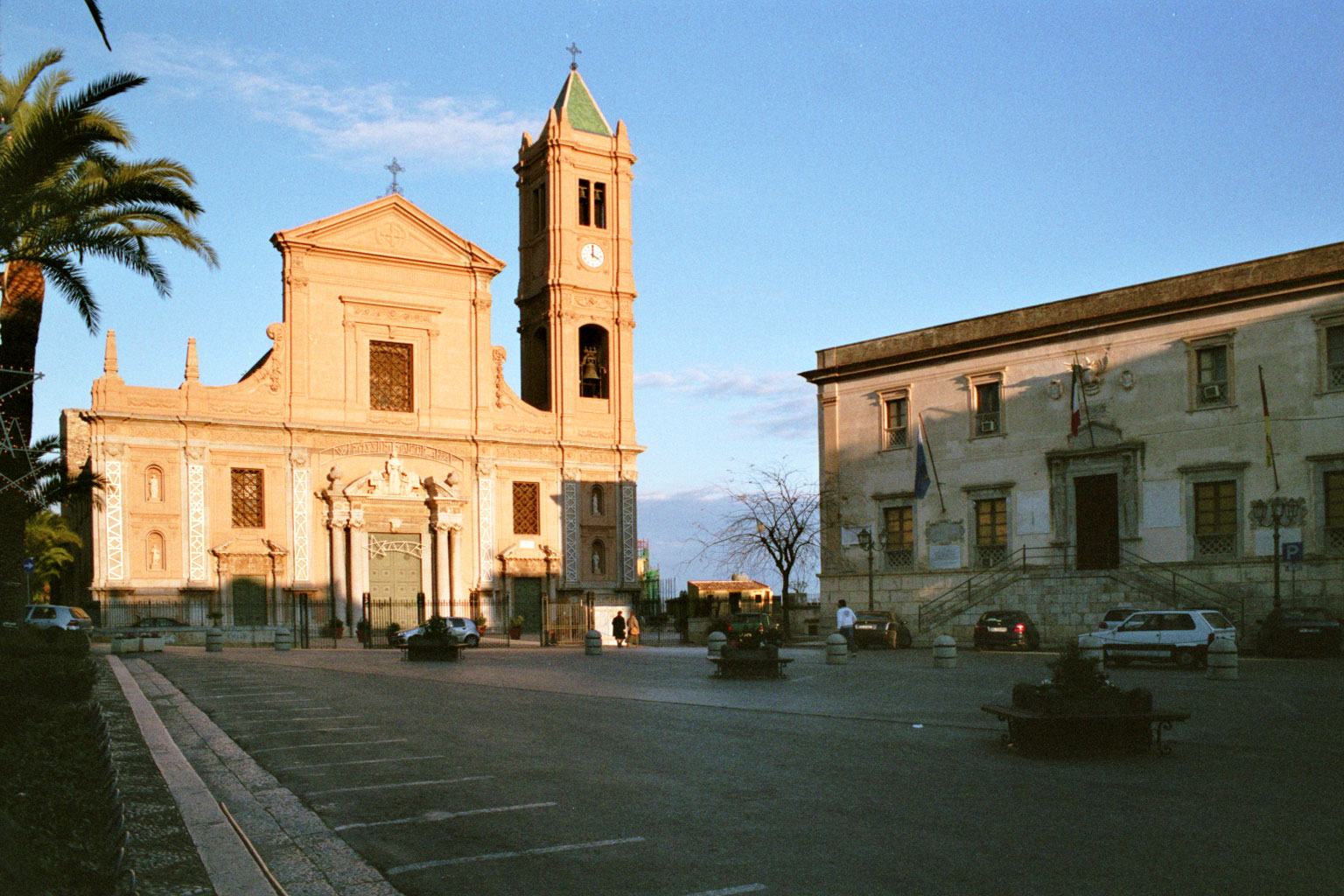
Both sets of my grandparents came from Sicily and were born in Termini Imerese, a very beautiful place. My grandfather DiNovo was a truck farmer and successful in real estate (in Albany, NY). My grandfather Sgarlata was in the produce business but lost a great deal in the depression.

Have you ever visited the island of Sicily? If so, which are your favorite places to visit there?

I have been to Sicily twice. I loved all of Sicily, not only for its beauty and people, but for its traditions etc.
File:Termini imerese bjs07-04.jpg

Do you think that there are still many aspects of Italian culture evident in the current American society?

I am sorry to say we have lost so much and our mission is more difficult as we lose the older generation. Our mission is more important than ever!
 

Which places in New York would you recommend to visitors looking to experience true Italian American culture?

New York State has the most people of Italian heritage in the USA. We have many Little Italys, Italian institutions, organizations, churches, stores, restaurants etc.


What have been the highlights of your career so far?

I have been knighted by the Italian government (Cav.). I am the founder of the Association and Museum and this is my 34th year as a volunteer. I taught on the college level for 32 years and received many awards. I thank God for the gifts he has given me and the opportunity to serve.


Thank you so much for your time. Would you like to provide any extra information for our readers who would like to join the association or read more about the museum?
Association Membership is $25 a year (plus postage for those outside the United States). Mail a check to us and send it to 1227 Central Ave, Albany, NY 12205 (USA)
 
We also have a great website www.americanitalianmuseum.org and a Facebook page and a free Email Newsletter. I hope all who read your article will pay us a visit or at least stay in touch by signing up for our free Email Newsletter.


Debra Santangelo

Wednesday, 15 May 2013

Viva Sant' Alfio & Recipe for 'Granita di Mandorla'!


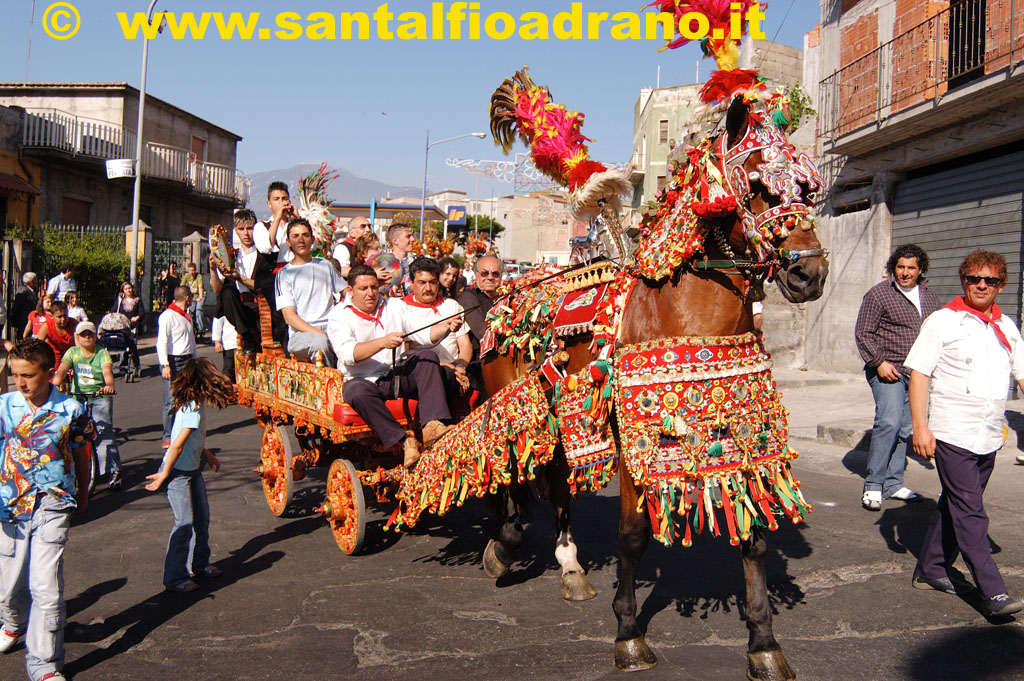
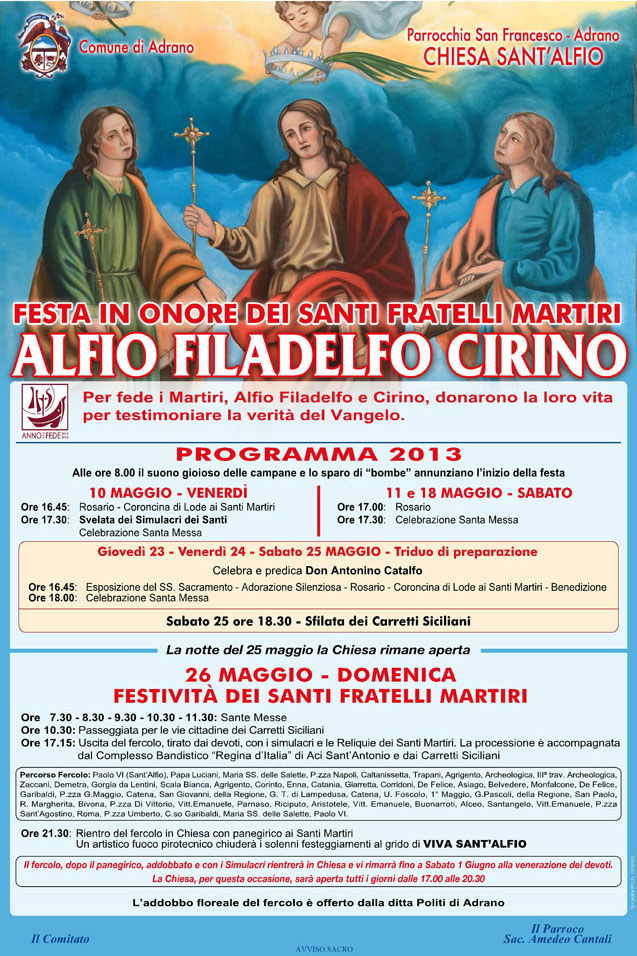
Buongiorno a tutti! I hope that you are all well and enjoying this lovely Spring sunshine. Today I want to write about one of my favourite festivals in Sicily which is the 'Festa di Sant'Alfio' in the town of Adrano. This festival will take place on the 26th May 2013 and features a parade of beautiful Sicilian carts being pulled through the streets by intricately adorned horses.


The first parade will take place on the 25th May at 6.30pm and the second will be at 10.30am on the Sunday the 26th May. The horse's riders are all in traditional costume and play Sicilian instruments whch makes for a very festive atmosphere. At 5.15pm on Sunday there will also be a procession of the three Saints - Alfio, Filadelfo and Cirino, the three young brothers who were martyred in the nearby town of Lentini in 253 AD.

Programma 2013 Sant'Alfio Adrano
 
 
Now that Spring is here it is also finally 'granita' time on the island of Sicily! This is one of my favourite Sicilian delicacies and is similar to a sorbet. Here is the recipe for Almond Granita which is my all-time favourite flavour! -
 
Granita di Mandorla
 
600 ml Water
250g Blanched Almonds
125g Caster Sugar
 
1) Put the almonds, sugar and the water in a blender and process until as smooth as possible.
 
2) Pour the resulting almond milk into a large sieve lined with a clean J-cloth or muslin set over a bowl. Leave to drip overnight. Help it along every so often by gripping the cloth and squeezing the liquid through. Squeeze as much liquid as you can from the almonds.
 
3) Pour into a shallow container and freeze, roughly forking the crystals 4 or 5 times during the freezing process. Serve.


When you have made your Granita di Mandorla, you can watch this video of last year's Sant'Alfio celebrations in Adrano while you enjoy it. Now you can truly feel that you are in the midst of the Sicilian springtime! -


Amici, if you enjoy reading my blog please become a follower by registering at the Google 'Join this site' icon at the top right of the page. Grazie mille for your support!!
 
A presto!
 
Debra Santangelo


Wednesday, 17 April 2013

Villabate Pastry Shop Advances Historical Novel Set in Sicilian Hometown

Buongiorno a tutti - I hope that you all had a wonderful Easter! Today I would like to share with you a recent article from our website written by the New York Arts and Business Consultant Roberto Ragone. It is about the most famous Sicilian pastry shop in New York - Villabate Alba in Bensonhurst, Brooklyn. Villabate have been involved with the recent 'Trinacria' campaign and this article gives some interesting insight about their 'Sicilian Connections'.


Villabate Pastry Shop Advances Historical Novel Set in Sicilian Hometown
 
 
Villabate is the name of the New York Metropolitan area’s finest Sicilian bakery and pastry shop. It is also the name of the ancestral town of the Alaimo family, who have owned and operated this Bensonhust institution for 35 years. For family and historical reasons, their hometown of Villabate, Sicily is now the primary setting for Trinàcria: A Tale of Bourbon Sicily, a novel that the Alaimos are helping to support and promote.
 
“This may be a case of the Princess and the Pastries, or of the Bourbons come to Brooklyn,” said author Anthony Di Renzo, whose roots also extend to Villabate. Inspired by a town legend, popular when patriarch Angelo Alaimo was still a boy, Di Renzo’s novel pays tribute to their common heritage.

The author’s great-grandfather, Antonio Coffaro, supposedly smuggled food and supplies to Giuseppe Garibaldi, whose troops invaded Sicily as part of the Risorgimento, the Italian unification movement of the mid-1800’s. Garibaldi and a hand-picked retinue came to Villabate and personally thanked him in the municipal square.

Di Renzo’s thanks, however, acknowledges the Alaimo family’s literary patronage. For contributing “dough” towards the book’s production and distribution, the Villabate-Alba Bakery and Pastry Shop will appear in the novel’s acknowledgment section.

Di Renzo’s collaboration with Villabate-Alba honors Sicilian family, Sicilian history, and Sicilian craftsmanship. “After all,” he said, “the Alaimos are artists, too.”
“Corporations aren’t the only ones who support the arts,” Di Renzo noted. “Small businesses are just as important.” His collaboration with Villabate-Alba honors Sicilian family, Sicilian history, and Sicilian craftsmanship. “After all,” he said, “the Alaimos are artists, too.”

For three generations the Alaimo family has created the finest Sicilian pastries, cakes, cookies and breads, whether in or in Bensonhurt, Brooklyn or back in Villabate, Sicily. The author’s mother, Maria Coffaro Bilo, and Angelo Alaimo, the founder of the Brooklyn pastry dynasty, were distant cousins and childhood playmates.
 
 
When the economic recovery from World War II proved too daunting, Angelo and his son Emanuele immigrated to America. For over a decade, the two worked hard as simple breadmakers in bakeries all over Brooklyn, earning a reputation for quality and craftsmanship. Encouraged by their neighbors and customers, father and son in 1979 started their own place: Villabate of 18th Avenue. On opening day, Di Renzo’s 48-year-old mother, who had moved to America several years before Angelo, drove in from New Jersey to be among the first customers.
 
Since then, Villabate-Alba has passed from Emanuele Senior to Emanuele Junior, Anthony, Lina, and Angela. As the family explained in a 2010 feature on Brooklyn Independent Television, Manny, “the quiet one,” runs things in the back; Anthony, “Mr. Personality,” entertains customers and handles the advertising and public relations; and Angela “basically bosses everyone around.” The new generation is proud of its Sicilian roots and visits Villabate almost every year. However, Trinacria became a rich source of knowledge, providing the Alaimo family a whole new perspective on their roots and their ancestral town’s actual history. 
 
From the days of the Kingdom of the Two Sicilies, Villabate, a suburb of 20,000 people, has been an important agricultural center in the Conca d’Oro, or Golden Conch, the fertile plain surrounding Palermo. In 1700, Antonio Agnello, an aristocratic abbé and an amateur botanist, founded a commune to develop the hardy strands of olive and citrus that became the area’s chief crops. Most of the town, not incorporated until 1858, would be parceled from the abbé’s huge estate; hence came the name Villabate, a contraction of Villa dell'Abate (Abbot’s Villa).

This land forms the heart of Trinàcria: A Tale of Bourbon Sicily. The book’s title derives from the ancient Greek name for Sicily. Trinàcria refers to the island’s triangular shape and the three-legged gorgon on its regional flag. It is also the nickname of the novel’s narrator and protagonist, Zita Valanguerra Spinelli (1794-1882), Marchesa of Scalea, who moved from Bagheria to Villabate to grow prized blood oranges. Her turbulent life mirrors Sicily’s rocky transition from feudalism to capitalism.Guernica Editions, an independent literary press in Toronto, Canada, plans to release the novel by November.

 
The Alaimo family played a key role in the book’s online campaign and live fundraising event, both sponsored by the Italian Cultural Foundation and Casa Belvedere and organized by consultant Roberto Ragone. The Villabate-Alba Bakery and Pastry Shop not only contributed money but supplied a large tray of ossi di morti for the November 29th reception at Umberto’s Clam House in New York’s Little Italy. Shaped like human bones, these traditional almond-paste cookies are served throughout the month when All Souls Day falls. They seemed a fitting symbol for a book whose narrator speaks from beyond the grave.

“We’re pleased to do whatever we can to move this book forward,” said Antonio Alaimo, “but we’re just as pleased to reconnect with a long-lost relative. Cousin Anthony and I share the same heritage. Sicilian stories and Sicilian sweets: who can get enough of them?”

Di Renzo agrees. “It’s about the tasting the past. I think of that passage in Proust, where he bites into a madeleine and remembers his childhood. A slice of cassata or a pistachio cannolo has the same effect on Sicilians and Sicilian Americans. It unlocks memories and brings back the dead, whether in Palermo or Brooklyn. In fact, I hope this all inspires post-St. Joseph's Day orders for zeppole and sfingi from Villabate-Alba.”

 
Readers may sample authentic Sicilian pastries at the Villabate-Alba Bakery and Pastry Shop, 7001 18th Avenue, Brooklyn.
 
Business hours are: Monday through Saturday, 7:00 AM to 9:00 PM; Sunday, 7:00 AM to 8:00 PM; Holidays, 7:00 AM to 6:00 PM. Villabate-Alba also ships practically anywhere. Order through their website at http://villabate.com and taste the past
 
 
I hope that you enjoyed this article! A presto :-)
 
Debra Santangelo


Thursday, 28 March 2013

Buona Pasqua!

Buongiorno a tutti i miei amici!! I hope that you are all well and finally enjoying some Spring sunshine :-)


We are now in Easter week which is one of the most significant periods in the Sicilian calendar. Every year, the atmosphere in Sicilian towns changes considerably throughout the week according to the day and its religious implications. Even the weather usually changes accordingly, with the week prior to Easter being dark and miserable only to give way to glorious sunshine on Easter Sunday. My own personal experiences of the week's events have mostly been in the town of Adrano, which is situated at the foot of Mount Etna, in the province of Catania. The processions are so elaborate and moving in this town, and they attract thousands of devotees.


Today the procession of 'Cristo alla Colonna' takes place from 6pm until 3am tomorrow morning, when the statue of Christ on the cross is carried throughout the streets of Adrano, calling in at each of the town's churches in order for the men carrying the statue to kneel at each altar. This is so emotional to watch as the statue is carried very slowly, three steps forward then two steps back, and sways from side to side.

On Good Friday from 7am until 2pm the statue of the Virgin Mary, l'Addolorata, is carried through the streets visiting each church looking for her son Jesus, and at 8pm there is the procession of 'Cristo Morto'. In dialect, this is 'U Lizzanti' and is the statue of the body of Jesus which makes four stops around the town, each time accompanied by a marching band playing the funeral song 'Canzoncina a Gesù morto'.


On Easter Sunday the sun shines bright in the sky and hundreds of families head towards the town centre to see the procession of 'Cristo Risorto' (Christ Resurrected), the Angel and of 'Maria Annunziata' (Virgin Mary).

The happiest time of the day is when the statues of Jesus and Mary finally meet and this is known as 'A Paci'. The statues are made to dance and kiss and the atmosphere in the piazza is so happy and uplifting. Adrano is renowned for 'la Diavolata', which is a theatrical production held outside in the piazza on Easter Sunday and depicts the fight between good (symbolised by angels) and evil (the devils). In the evening the town holds an incredible fireworks display.


I wish each one of you a 'Buona Pasqua' and leave you with a video in Italian showing the highlights of Easter in Adrano -


Amici, if you enjoy reading my blog please become a follower by registering at the Google 'Join this site' icon at the top right of the page. Grazie mille for your support!!

A presto :-)

Debra
www.sicilianconnections.com

Monday, 4 March 2013

My Interview with Joe Zarba - Renowned Sicilian-American Photographer

Buongiorno a tutti! I recently interviewed a friend of mine, Joe Zarba, who is a very talented photographer based in Brooklyn, New York. Joe's parents were born and raised in Italy and 10 years ago he started to research his ancestral town of Leonforte in Sicily. I would like to share some of this interview with you as it gives a great insight into his photography and is an inspiration to those researching their own Sicilian ancestry -


Good Morning Joe. Please can you tell us a little about yourself and how you became interested in photography?

First, may I thank you for the privilege of this interview.

I was born in Jersey City, New Jersey and grew up a very happy child in Union City, NJ. As a child the saddest thing was that my father, who grew up in Sicily, died when I was 13. This event has coloured and shaped my entire life.

I spent the major part of my adult life teaching photography in a middle school here in Brooklyn, NY. It was something I always wanted to do, but never thought I’d have a chance to do, so I never gave it a second thought and then it was dumped in my lap so to speak. There were two cameras and two enlargers at the school and I proudly say I developed (no pun intended) a very reputable program over the course of 20 years. Ironically, I didn’t pick up a camera until I was 26, which was quite a while ago!

As far as instruction, I am completely self -taught, having gotten my first camera from my father-in-law of my first marriage. The camera had no light meter so I wrote down every exposure and under what conditions I shot until I really learned light.
 
I read everything I could get my hands on and I still have the major periodical that taught me everything. It was an issue of a magazine called Modern Photography and the article was entitled, “Everything you Need to Know about 35mm Photography” Even though we are in the digital age, I consider it still to be a classic of basic fundamental photography.

While the technology changes, the science remains the same. A special thanks goes out to Jim Marsh, who needed a place for his enlarger and used my basement. It was Jim who taught me how to print.

My photography now is really relegated to my images of Sicily, many of which can be found on my blog siciliabedda-beddasicilia.blogspot.com

I have ideas for lots of projects but four grandchildren happily fill up a major part of my life.
One project in particular, is finding, interviewing and photographing people who were born in Sicily, emigrated and then went back, a story in reverse so to speak. We’ll see what happens with this, but if anyone knows of people in this category, I would be forever grateful to speak to them.


San vito.jpg

Can you please explain to us your connections to the island of Sicily?

I grew up in an Italian culture. My mom was born here, also in New Jersey of parents from Campobasso on the mainland and my father was raised with his three brothers and two sisters in Sicily before he and two brothers separately emigrated to the U.S. I used to sit and look over my dads’ shoulder as he wrote letters home every week. Phone calls were out of the question.

My mother who passed away in 2002 was as wonderful as any child could ask for but I was always a daddy’s boy. My mom was the disciplinarian and he always protected me! When he died, there was a hole in my heart which I carried with me, mostly unconsciously, until 1988 when I made my first trip to Sicily with my wife Susan whom I credit with being the driving force in my finding my father’s family, connecting, building a relationship and giving me the closure I never had.

On that trip, we happened to drive to Nissoria (EN) where my two aunts and uncle lived. Fortunately, there was a guy from Queens NY staying with them who did all the translating as I knew only American-Italian which was just a combination of Italian words, real or imagined. I never got the story of why this guy was there or his connection but this was a beginning.

It wasn’t until about 15 years later, when my wife Susan noticed that most of my photos, whether here or there, were of older men. She stated the obvious; “Joe, you are looking for your father”. After having been to Venice to photograph Carnevale three times, she said, it is time you went to Sicily to find your family. The obviousness of this statement changed my life. Fast forwarding, In October of 2003, I believe it was, I wrote an e mail to the ‘comune’ in Leonforte where I knew my cousin was (the aunts and uncle had all passed away by this time). I was almost glad they didn’t respond because of my language fears and the thought of having them believe I was a relative.

Bar vitelli - landscape.jpg

Anyway, the following February I went to Carnevale in Acireale, Sicily “armed” with a photo book of our entire family including my cousin Angela when she was a child. One Friday it poured and all the events were cancelled for the day. I said, what the heck, and I decided to drive to Leonforte trying to time my drive so the ‘comune’ would be closed for ‘pranzo’ and maybe for the weekend! Well, they were open! I took a deep breath, walked in and introduced myself. All of a sudden I was mobbed and apologies were given for not having gotten back to me. They remembered the email as soon as I introduced myself!

We chatted, they took all my information again and promised to do a search and get back to me. This being the town where my dad grew up, I did not want to leave so I just walked the town looking for the oldest people I could find to ask if they knew anyone with the last name Zarba not knowing that in Sicily it is pronounced differently as Zarba`. After a few hours of ‘No, mi (or ci) dispiace”, I decided to return to Acireale.
As I was going down the hill, a little old fiat cinquecento pulled in front of me, motioned for me to get out of the car. The man inside was the same man, Gianmaria, I met in the ‘comune’. He handed me a post it with information and told me to, “Go back into town, go to a bar and ask for help. THIS IS YOUR RELATIVE”!

I reluctantly did just that and a man in the first bar I went into KNEW my cousin so we walked to her apartment, (which is the same apartment my father and his siblings grew up in) rang the bell and this woman and her daughter came down. He told them, “This gentleman is from New York and SAYS he is a relative of yours”. I showed her the book and she knew it was true because there she was with her mother, aunt and uncle.as well as those who emigrated. The story goes on and on but I could feel the hole finally closing.


How did it feel to finally visit Leonforte, the town that is so important to your family?

It is one thing to visit the town but can you imagine going to the same home your father or mother grew up in? I still get goose pimples thinking of it! Of course it has been renovated but walking the three floors is a journey in my father’s mind and shoes. I imagine conversations he may have had with his parents, brothers or sisters. I imagine what it may have looked like one hundred years ago as he was born in 1902. It is something so personal that trying to describe it takes away from the actual experience.

I hope you enjoyed this extract of the interview. To see the rest of the questions please go to - http://www.sicilianconnections.com/?c=15336.

A selection of Joe Zarba’s Sicilian photography is available to buy at http://www.sicilianconnections.com/Art-Store_11457.html.


A presto :-)

Debra Santangelo
www.sicilianconnections.com

P.S. If you enjoy reading my blog please become a follower by registering at the Google 'join this site' icon at the top of the blog page. Grazie mille for your support!!